
ProX Carbon Wheel Rolling Fatigue Test
Durability is a critical factor for high-performance bicycle wheels. During real riding, wheels are subjected to continuous rolling loads, repeated road vibrations, and lateral forces generated during sprinting and cornering. Over time, these cyclic stresses may lead to structural fatigue if the wheel is not properly engineered. The Wheel Rolling Fatigue Test is designed to simulate long-term riding conditions in a controlled laboratory environment. By repeatedly applying both radial loads and lateral loads while the wheel rotates, the test evaluates the long-term structural endurance of the wheel system. At PROX, all wheels undergo both Radial Fatigue Test and Lateral Fatigue Test to ensure durability, reliability, and rider safety over extended use.
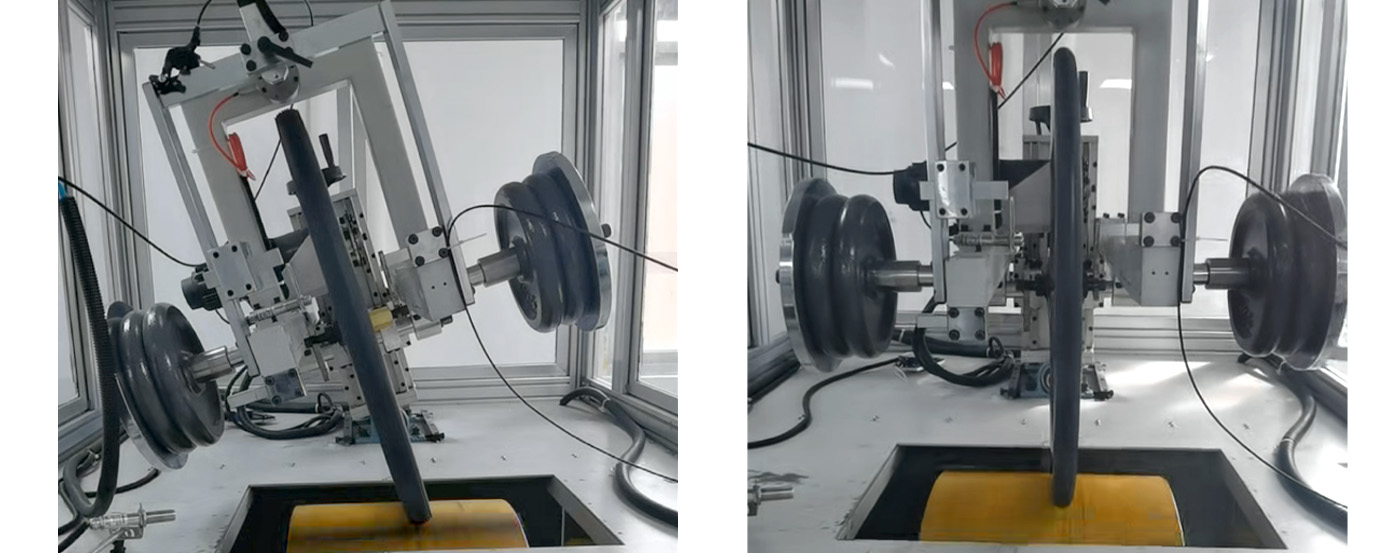
Radial Fatigue Test
Purpose of the Test
The Radial Fatigue Test simulates the repeated vertical loads that occur when a rider’s weight presses the wheel against the road surface during riding. Each rotation of the wheel generates compression between the rim and the ground. Over long periods of riding, these repeated vertical forces may cause structural fatigue in poorly designed rims or spoke systems. This test verifies that the wheel can withstand long-term vertical loading without cracks, deformation, or structural failure.
Test Conditions
The wheel is mounted on a rolling fatigue testing machine and pressed against a rotating drum while a constant vertical load is applied.
| Test Item | Test Condition |
| Loading | 85 kg |
| Rolling Speed | 25 km/h |
| Test Cycles | 1,000,000 cycles |
| Test Standard Requirement | 750,000 cycles |
During testing, the wheel rotates continuously while carrying the applied load. Engineers monitor the wheel throughout the process to detect any structural changes.
Test Result
PROX carbon wheels successfully completed 1,000,000 radial rolling cycles, which exceeds the industry standard requirement of: 750,000 cycles.
After testing, the wheel must show:
- No structural cracks
- No rim deformation
- No spoke breakage or loosening
- No loss of structural integrity
What the Radial Fatigue Test Verifies
The radial fatigue test evaluates:
- Rim durability under repeated vertical compression
- Structural strength of the carbon rim
- Long-term stability of the spoke tension system
- Durability of the rim-hub interface
Passing this test confirms that the wheel can withstand prolonged real-world riding loads.
Lateral Fatigue Test
Purpose of the Test
In addition to vertical forces, bicycle wheels experience repeated side loads during riding. These forces commonly occur when:
- Cornering at high speed
- Sprinting out of the saddle
- Climbing while rocking the bike
- Riding on uneven road surfaces
The Lateral Fatigue Test evaluates the wheel’s ability to resist repeated side forces without structural fatigue or loss of stiffness.
Test Conditions
The lateral fatigue test uses the same testing parameters as the radial fatigue test, but applies repeated side loading to simulate lateral riding forces.
| Test Item | Test Condition |
| Loading | 85 kg |
| Rolling Speed | 25 km/h |
| Test Cycles | 1,000,000 cycles |
| Test Standard Requirement | 750,000 cycles |
During the test, the wheel rotates continuously while lateral force is applied repeatedly to the rim, simulating the side stresses experienced during real riding conditions.
Test Result
PROX carbon wheels successfully completed 1,000,000 radial rolling cycles, which exceeds the industry standard requirement of: 750,000 cycles.
After testing, the wheel must show:
- No cracks in the rim structure
- No rim deformation
- No spoke loosening or failure
- No structural damage
What the Lateral Fatigue Test Verifies
The lateral fatigue test confirms:
- Long-term lateral stiffness durability
- Resistance to side-load fatigue
- Structural stability of the spoke bracing system
- Overall integrity of the carbon rim structure
This ensures reliable performance during aggressive riding situations such as sprinting and high-speed cornering.
Why Rolling Fatigue Testing Matters
Fatigue failure is one of the most critical risks for bicycle wheels during long-term use. Even a strong wheel may eventually fail if its design cannot withstand repeated stress cycles. By performing both Radial Fatigue Tests and Lateral Fatigue Tests, PROX ensures that every wheel is capable of handling the combined forces experienced during real-world riding. All ProX wheels are tested to 1,000,000 cycles, exceeding the 750,000 cycle industry requirement, demonstrating excellent durability and reliability for long-term riding performance.


